Monday, December 12, 2016

Trial and Error


Trial and Error

One of the great things I’ve learned this semester in listening to the Hero stories, reading case studies, and watching inspirational talks, is that failure is part of life, career, and business. An entrepreneur I look up to because of his fearless, brash attitude in business and life is Richard Branson, founder of Virgin Records, Virgin Atlantic, etc., etc. He has experienced great success and also failure. He candidly writes about both and how one can learn from each.

The reason he seems so fearless is because he feels that if you have not failed then you have not taken any risk. Not taking risk guarantees that you will experience little or nothing new and he thinks that is a terrible way to live your life or do business. Overcoming the fear of failure is key to taking risk. Taking risk is meant to feel scary, but he says that just makes it interesting and exciting.

Branson has certainly led an exciting life with plenty of failure to overcome. One of his greatest failures was his attempt to enter the lucrative soft-drink business with Virgin Cola. He spent millions on promotion and advertising and priced his product 15-20 percent lower than brand giants Coke and Pepsi, but failed to make a profit. His biggest learning experience from this failure was to never underestimate your competition. He learned that Coke and Pepsi are not “sleeping giants” that are complacent or not protective of their market share. Another recent and devastating failure recently, was the crash of his Virgin Galactic SpaceShipTwo last year. Branson and those working to make public space travel a reality have learned much from the accident and are moving forward. They recently announced a partnership with NASA to share technology and test facilities. They have also been able to achieve commercial success with LauncherOne, a small satellite launching service.

He notes that the only time a failure is a true failure is when you do not learn from it. He said, “There were countless times during our record-breaking hot-air balloon trips when I wondered whether we were going to make it back down to Earth alive. But every time, I learned lessons from making mistakes during previous trips and was able to adapt.” Richard Branson sums it up this way, “Failure is never easy, but it’s an inevitable part of every personal and business journey. It’s important to realize this. Most, if not all, of the world’s finest minds, innovators and game-changers have failed at some point. However the reason that they eventually succeeded was because they didn’t let their failings deter them.”

My plan of action to implement a life and business strategy around these concepts will be one that puts the fear of failure in proper perspective. One of the things I need to do if I launch another business will be to take the time to look back at my failures and document why they happened and what I can do in a future venture that would minimize these risks. I will continue to look to other leaders and examples of courage for ways I can implement their positive attitudes in my life and business. One of the greatest things I learned from my failures was that they were temporary. I will have faith in and hold fast to the Lord’s counsel to Joseph in Liberty Jail when he said, “And if thou shouldst be cast into the pit, or into the hands of murderers, and the sentence of death passed upon thee; if thou be cast into the deep; if the billowing surge conspire against thee; if fierce winds become thine enemy; if the heavens gather blackness, and all the elements combine to hedge up the way; and above all, if the very jaws of hell shall gape open the mouth wide after thee, know thou, my son, that all these things shall give thee experience, and shall be for thy good.” D&C 122:7

Friday, December 9, 2016

An Attitude of Gratitude


An Attitude of Gratitude

 I love the talk by our modern-day Prophet, Thomas S. Monson, “An Attitude of Gratitude” given in General Conference in April 1992. Recently, my wife and I used it as a subject for fireside talks we shared with our ward’s single adult group. I firmly believe that a positive attitude and gratitude go hand in hand. I love President Monson’s summary of this relationship, “We can lift ourselves, and others as well, when we refuse to remain in the realm of negative thought and cultivate within our hearts an attitude of gratitude. If ingratitude be numbered among the serious sins, then gratitude takes its place among the noblest of virtues.” (https://www.lds.org/general-conference/1992/04/an-attitude-of-gratitude?lang=eng&query=attitude+gratitude+ (name%3a%22Thomas+S.+Monson%22)
 
 
Image result for gratitude
Just a couple of weeks ago we celebrated Thanksgiving and I was able to reflect on the great bounty of blessing we enjoy in our lives. I am so grateful for this land we live in, the freedoms we enjoy, and the level of comfort we pass each day in. I have been blessed with a wonderful eternal companion, a great family, and choice children. I go to work each day in the comfort of a reliable car and work at something I enjoy. I am blessed to work with great individuals. I have been blessed to be born into a home where the gospel was taught and lived. I have been blessed with spiritual experiences and a testimony of eternal truths through the Holy Ghost. We are able to have personal communication with deity, our Father in Heaven. He loves us so much that he sent his Only Begotten Son to suffer and die for us. With all these blessings, how can we not be the happiest people on earth?

Sunday, December 4, 2016

Reflections

Analysis of “What’s a Business For?” by Charles Handy
  • Why are virtue and integrity so vital to an economy? Handy describes this importance in a free market in this way, “Markets rely on rules and laws, but those rules and laws in turn depend on truth and trust. Conceal truth or erode trust, and the game becomes so unreliable that no one will want to play.” (Case Study) This is why in pre-socialist or fascist countries there is a collapse of business because if there is a chance that the government will take over industry (in reality, government theft/dishonesty) then there is no incentive for privately owned business.
  • According to Charles Handy, what is the “real justification” for the existence of businesses? “The purpose of a business, in other words, is not to make a profit, full stop. It is to make a profit so that the business can do something more or better. That “something” becomes the real justification for the business.” (Case Study)
  • What are two solutions proposed by Handy that you agree with? Why? The first I agree with would be, “doing good does not necessarily rule out making a reasonable profit. You can, for example, make money by serving the poor as well as the rich.” He gives a couple of examples of this and I personally have been involved in some micro-lending through the website kiva.com. The second solution I agree with would be for business to “measure success in terms of outcomes for others as well as for ourselves.” As a business owner I took great pride in providing a livelihood for my employees. I truly believe in the business owner’s mantra that your employees get paid first.
The Journey of Becoming
As I reported this week on the book “A Field Guide for the Hero’s Journey” by Jeff Sandefer & Rev. Robert Sirico, it became very clear to me what my journey in life should entail. Each step on the journey, each thought in my mind, each word spoken to those around me, every choice I make, and each action take should be helping me become as the Savior Jesus Christ. This type of clarity drives out doubt and fear, gives me the strength to overcome challenges, and increases my faith and trust in the Lord. What a powerful perspective on this life as well as the eternal nature of our souls.


Wednesday, November 23, 2016

Balance


Work-Life Balance

One of the persistent themes when exploring the entrepreneur and the life that that entails is finding a balance between business goals and family needs. There are some incredible pros to the entrepreneur’s life and also some potentially disastrous cons, especially when it comes to family life. The incredible pros include: freedom of time, potential personal economic security, and ability to follow your passion. The potentially disastrous cons can be: following business passion to the exclusion of family and friends, personal economic uncertainty, chasing the next big idea, and never finding satisfaction or fulfilment. These are very real and finding a balance that works for me individually requires some flexibility (it is a dynamic balance that can change through lifes stages) but also requires some inflexibility or strong commitment (when it comes to sticking to your priorities and principles).

Attitude on Money

In a talk titled, “Attitude on Money” Stephen W. Gibson explored the role money plays in our mortal lives and how it relates to the temporal as well as spiritual elements of our lives. Reading it was a good way to prompt reflection on how I felt about money.
 

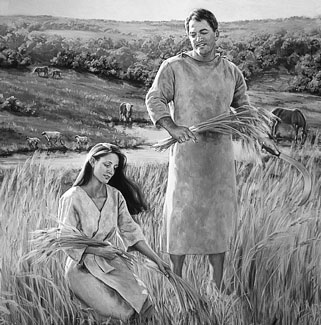
    Image result for adam and eve working
  • What is your attitude toward money? Whether you regard money as an end to a means or just a representation of work, reward, or time, it is clearly a measuring factor for all three. As that, money has no power or lure. It is just a tool.
  • How can your view of money affect the way you live? Keeping a temporal perspective on money, what it represents, and its temporary nature is key to keeping it in a proper perspective. If I live my live guided by eternal perspectives and priorities, money and the pursuit of material possessions will always have a subservient role and priority.
  • What rules are recommended for prospering? One of the most recurring themes from the Book of Mormon is “For the Lord God hath said that: Inasmuch as ye shall keep my commandments ye shall prosper in the land; and inasmuch as ye will not keep my commandments ye shall be cut off from my presence.” (2 Ne 4:4) Prosperity is a byproduct of a righteous life and so the goal should be to first, live a Christ-centered life and the temporal will be provided for. A secondary theme from the scriptures is the principle of industry and work.And it came to pass that after I, the Lord God, had driven them out, that Adam began to till the earth, and to have dominion‍ over all the beasts of the field, and to eat his bread by the sweat of his brow, as I the Lord had commanded him. And Eve, also, his wife, did labor‍ with him.” (Moses 5:1) And in the Book of Mormon, “And I did cause that the women should spin, and toil, and work, and work all manner of fine linen, yea, and cloth of every kind, that we might clothe our nakedness; and thus we did prosper in the land—thus we did have continual peace in the land…” (Mosiah 10:5)

Friday, November 18, 2016

Those Who Went Before

Those Who Went Before


Mentors, trailblazers, leaders, role models, all titles for those who go before us and sometimes walk beside us or reach back to lift us up. As we’ve had the chance this week to interview an entrepreneur and hopefully learn from their struggles, triumphs, experiences, and wisdom gained, we have become better for it. What an almost insurmountable task it would be if we had to start from scratch with everything we did! I learned this at a pretty young age as I got my first real full-time job. It was as a structures mechanic for Rockwell, Intl. building the B1-B bomber. At age 18, I was amazed at the complexity of that machine. It was obvious that no one person in multiple lifetimes could come up with the science, workable design, technology, materials, tooling, and skills needed to build this plane. It was the result of centuries of men and women searching for knowledge and truth, experimenting, sharing their knowledge, and building on the knowledge of those who went before.


This week caused some reflection on what kind of link I am in this chain of human progress. Am I a strong link that learns from those who went before or do I reject their wisdom in favor of something else? Do I share my experiences in the hope that mankind (or at least those in my spheres of influence) can fast-track future progress? Am I a leader? Am I an example? Am I a mentor?

Picture above - My workstation at Rockwell Intl. B1-B Final assembly.
Image courtesy of - http://www.aviationspectator.com/files/images/B-1B-Lancer-120.jpg

Thursday, November 10, 2016

Leadership


Leadership


This week hit home in a very big way. Two weeks ago as I was set apart as Bishop and many feelings, questions, and thoughts have come to my mind in the intervening days. I have thought about how the Lord has prepared me to lead our ward and yet to serve the ward and serve the Lord. As I read again, for maybe the fourth or fifth time, President Clark’s 2007 BYU-Idaho commencement address, it took on a very new and clear meaning for me this time. As I read, “The call to be a disciple-leader is a call to minister and to serve.  It is a call to lead as Christ leads.  It is leadership with a small “L”—the kind of leadership that builds and lifts and inspires through kindness and love and unselfish devotion to the Lord and His work.  It is the kind of leadership that we need at every level of every kind of organization in the world and in every ward and stake in the Church.” the words seemed to be directed to me and pertained to me in my new calling. As I’ve met with the auxiliary leaders I have a new-found sense of gratitude for their level of devotion and service and look to them as examples of how I should serve. I have had a sense that a big part of my service and leadership will be in following the example of the Savior and reaching out to the one. Over and over I have had the vision of finding one who is lost and bringing them back into the fold rejoicing just as in the parable of the ninety and nine. This week has brought me the blessing of a renewed desire to be a leader with a small “L” as described by President Clark.

Tuesday, November 1, 2016

Looking Back and Moving Forward


Looking Back and Moving Forward

This week’s blog title comes from a talk by President Thomas S. Monson titled, “Looking Back and Moving Forward” which he delivered just after being sustained as Prophet and President of the Church, “Members of the Church around the world convened yesterday in a solemn assembly. You raised your hands in a sustaining vote to approve the action which was taken in that meeting in the temple to which I have just referred. As your hands were raised toward heaven, my heart was touched. I felt your love and support, as well as your commitment to the Lord.” (https://www.lds.org/general-conference/2008/04/looking-back-and-moving-forward?lang=eng) A week ago Sunday. I had a similar experience as I was sustained as Bishop of our ward. It is a very humbling experience as I questioned why and especially why now? When I met with the Stake President and he extended the calling, I was very conflicted when I thought about bending my will to the will of Heavenly Father. I felt how the Lord had led me to a career and position that provided the opportunity to get more education and complete a degree. Why was He now asking something of me that would put that goal in jeopardy? I had experienced miracles that had brought me to this point and did not nor do not yet fully understand the whys. But, as I saw the signatures of the First Presidency on the approval for the call, including President Monson’s, I knew how I would respond. I would trust in the Lord and have faith in His perfect knowledge. Especially his knowledge of me that even I do not know or understand.

Throughout the semester as we have delved into the entrepreneur’s journey, I have had and shared many moments of self-reflection. As this week’s course introduction stated, “The Entrepreneur Journey will not be easy. You will encounter many challenges and hardships along the way. These will be defining moments that will mold and shape you.” This is a very appropriate statement for young students. For me, it is an affirmation of my life experiences. So, this week I look back at my journey and with a renewed determination I look forward and move forward in this journey with a clear resolve to more earnestly seek to know the Lord’s will for me and sincere desires to do it.